In August 2023, something shifted in Uganda. Not quietly, not gently — but with the heavy, unmistakable thud of a law landing on real lives.
The Anti-Homosexuality Act had just come into force, and for months many in our community had lived with a question sitting in our throats: Who will be first? Who would be the first person the state decided to make an example of? The answer came from Soroti. His name was Micheal Opolot.He was only twenty years old.
When police arrested him in mid-August 2023 and later charged him with “aggravated homosexuality,” it didn’t feel like just another case. It felt symbolic, almost staged — as though the law needed a body to prove its power. Under the new Act, the charge carried the harshest punishment imaginable: death.
For many LGBTQ+ Ugandans, that moment crystallized a fear we had been trying not to name. The law was no longer abstract. It had a face, a name, a prison cell. Opolot was denied bail more than once. Court dates dragged on. Months stretched into more than a year behind bars. Like so many people caught in Uganda’s remand system, time itself became punishment.
But outside the courtroom, something else was happening — something quieter, less visible, but just as powerful. Lawyers kept showing up. Human rights defenders tracked every development.
Community members followed the story closely, refusing to let it disappear into silence. And slowly, the fight widened.
What began as one young man’s case became part of a much larger legal reckoning with the Anti-Homosexuality Act itself. Constitutional challenges made their way through the courts. Advocates questioned not just the arrest, but the very foundation of the law.
In April 2024, the Constitutional Court delivered a complicated decision. Much of the Act survived, but key provisions were struck down. Among them were elements that defined “aggravated homosexuality” in ways that violated basic rights to health and privacy. It wasn’t a sweeping victory, but it was a crack in the wall.
Cracks matter. They let light in.
Months later, Opolot was finally granted bail. After more than a year on remand, he stepped outside prison walls. For those who had been following his case, that moment carried a strange mix of relief and anger — relief that he was free, anger that freedom had taken so long.
Still, something had changed. The ground beneath the case was no longer stable.
As proceedings continued, the “aggravated” label grew harder to defend. Prosecutors faced increasing scrutiny. The death penalty — once wielded as a threat — became legally complicated and politically costly. The evidence didn’t quite fit. The burden of proof grew heavier. The international spotlight didn’t help either. What had once looked like an open-and-shut example began to unravel.
Then, this week — and finally, yesterday — the waiting ended.
After years of hearings, adjournments, and legal back-and-forth, the courts brought Micheal Opolot’s case to a close. The feared conviction for aggravated homosexuality did not stand. The death penalty was not applied. Instead, the charges were downgraded or dismissed, weakened by procedural gaps and the absence of the so-called “aggravating” evidence.
He walked out of court a free man.
The decision also reflects a broader legal reality that has been taking shape: Uganda’s higher courts have increasingly limited the use of extreme punishments for consensual adult relationships, drawing clearer constitutional boundaries around how far the state can go. For the first person ever charged under this law, that boundary made all the difference.
It did not come with celebration or headlines. It came quietly. But it came.
It would be easy to call this a small win. The Anti-Homosexuality Act still stands. Same-sex relationships remain criminalized. Arrests, blackmail, and harassment continue. The fear has not vanished.
Hope does not always arrive as fireworks. Sometimes it shows up as a ruling read out in a courtroom. As a charge that fails to stick. As a young man stepping back into daylight instead of returning to a prison van.
Sometimes hope looks like survival.
Today, Micheal Opolot’s story feels different than it did in 2023. It is no longer only the story of the first arrest under a harsh law. It is also the story of a case that did not break him — or us.
It reminds us that even the harshest laws are not invincible. They can be challenged, chipped at, weakened. It reminds us that legal systems, however hostile, still contain spaces where resistance can take root. And it reminds us that community — lawyers, activists, journalists, ordinary people paying attention — is often what keeps someone alive long enough to see justice shift.
At Kuchu Times, we tell these stories because memory is power. Because we are more than statistics and arrests. Because our history is not only made of pain, but also of endurance and unexpected victories.
Yesterday, a young man walked free.
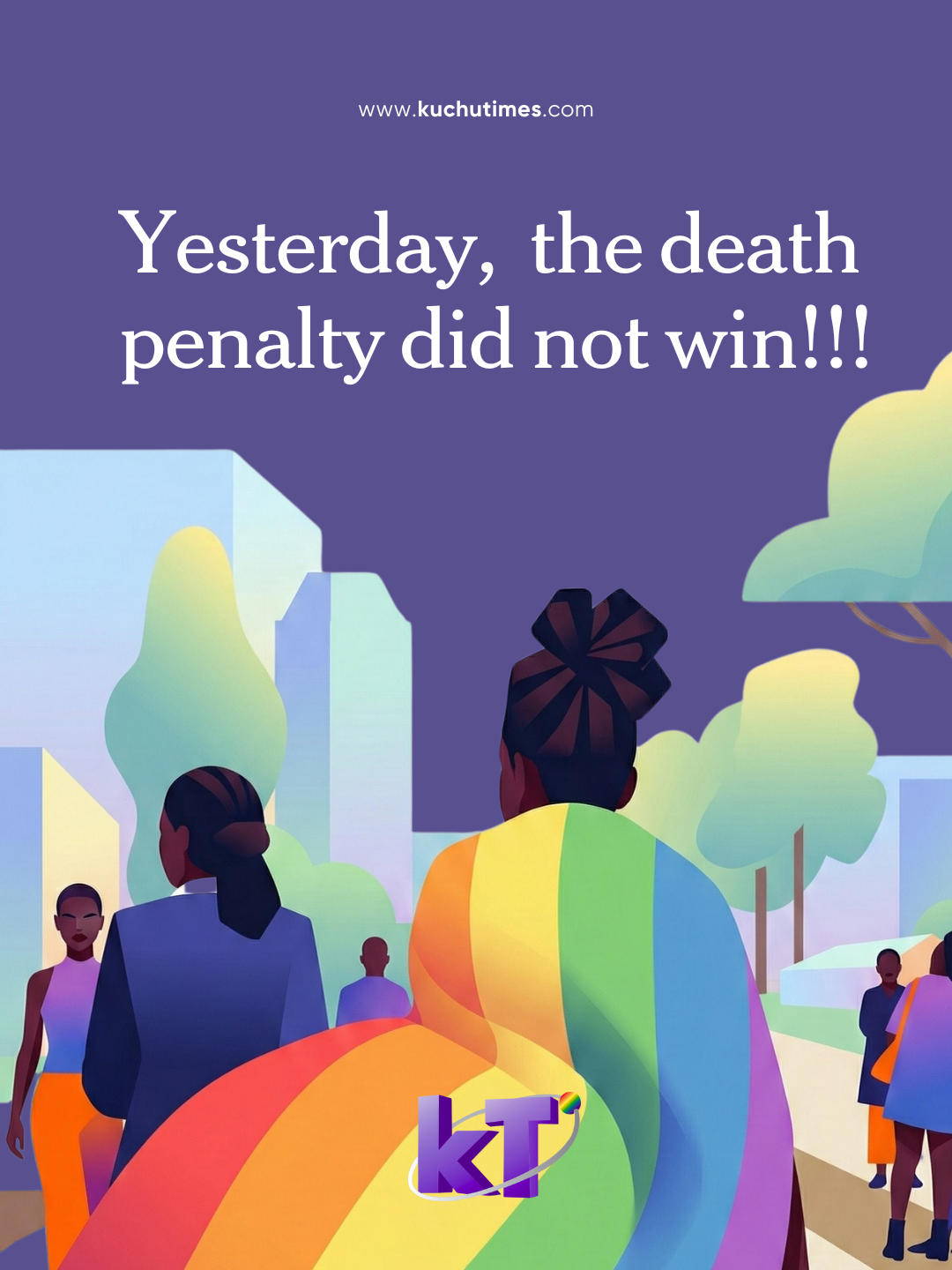
Yesterday, the death penalty did not win.
And in times like these, that is more than enough to keep going.