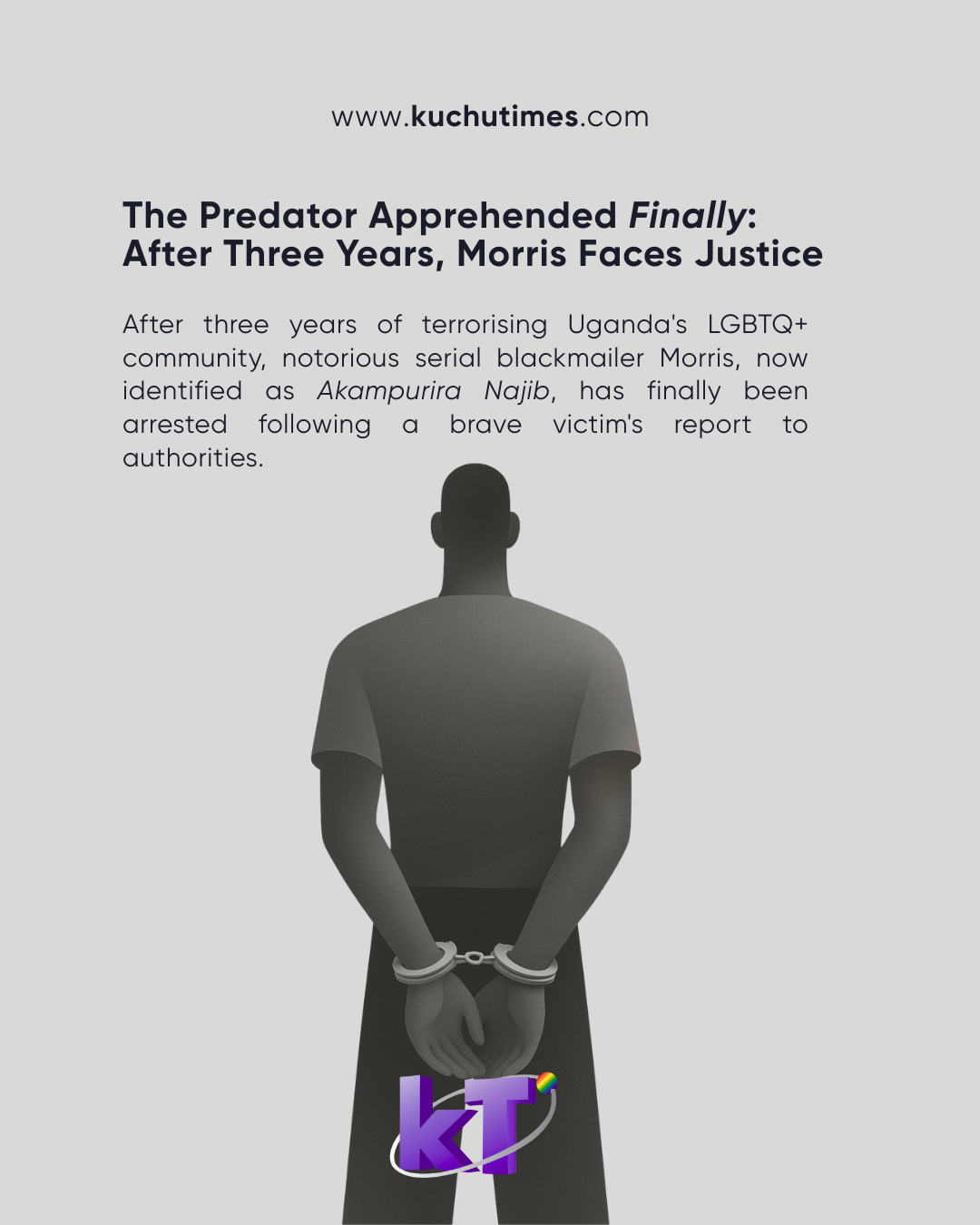
After three years of terrorising Uganda’s LGBTQ+ community, notorious serial blackmailer Morris, now identified as Akampurira Najib, has finally been arrested following a brave victim’s report to authorities.
By KuchuTimes Media Group
A video circulating in queer WhatsApp groups and on TikTok last Tuesday showed the arrest of a man who has haunted Uganda’s LGBTQ+ community for over three years. The man in custody is Akampurira Najib alias “Morris”, a serial blackmailer whose reign of terror has left over 150 documented victims in his wake.
Morris’s arrest comes after a courageous victim, despite the significant personal risks involved, reported him to authorities for extortion and blackmail. This breakthrough represents a rare moment of accountability in a country where LGBTQ+ individuals often find themselves criminalised rather than protected when seeking justice.
A Pattern of Predation
Morris’s criminal enterprise has been well-documented by the Uganda Minority Shelters Consortium (UMSC) and its partners, who have tracked over 150 cases of extortion, torture, blackmail, arrests, and harassment perpetrated by Morris and his network of accomplices over the past three years.
“These cases are merely a tip of the iceberg,” warns John Grace, the Consortium Coordinator, “fear prevents countless others from coming forward, leaving many victims trapped in ongoing cycles of extortion and blackmail.”
The serial blackmailer’s modus operandi evolved significantly after the passage of the Anti-Homosexuality Act in 2023, which emboldened him to escalate his operations from simple theft to a sophisticated network involving police collaborators, boda-boda riders, and community mobs.
Recent Victims Speak Out
The months leading up to Morris’s arrest were marked by increasingly desperate online pleas from victims. In July 2025, one victim shared a harrowing account of barely escaping Morris’s trap near Kabalagala:
“A huge group gathered, shouting, ‘Ono musiyazi.’ One man, the one who had slapped me, was leading them. He took out his phone, showed me the Grindr chat and my picture, and said, ‘Is this not you? Aren’t you gay?'”
The victim described how Morris demanded 10 million shillings and threatened to take him to Kabalagala Police Station, which he had heard was “their den.” Only by jumping over a Shell petrol station fence and causing a public commotion did the victim manage to escape.
Another victim, using the pseudonym Benaflic, recounted how Morris used fake photos of King Oyo to lure him into a trap in August 2024:
“He held me by my trousers, around the waist, and said I was gay and he was taking me to the police… He took my iPhone 13 Pro Max, called my dad, and asked for 1.5 million shillings from him after disclosing my sexuality to him and telling him that I had been arrested.”
This incident occurred on the eve of the victim’s birthday, adding a particularly cruel dimension to Morris’s methods.
The Community Fights Back
The LGBTQ+ community’s response to Morris’s terror campaign demonstrates remarkable resilience and solidarity. Online platforms became crucial tools for sharing warnings and safety information.
Community alert pages like @KitoAlertUganda and @LGBTQ_Confesses on X (formerly Twitter) played vital roles in disseminating information about Morris’s activities. These platforms shared updates about his latest phone numbers, operational areas, and methods:
- Community Alert about Morris using “Copy” username on Grindr
- Comprehensive warning with Morris’s photos
- Latest phone number alert
- Safety tips and operational patterns
- Recent victim testimonies
One particularly detailed warning from September 2024 described Morris’s methods with chilling precision:
“From the patterns I’m seeing, I’d say he doesn’t want to meet in public places like bars, restaurants, or clubs. No, he deals with stuff like, ‘Come here at this school, or black gate, blah blah.’ And the moment you hear, ‘How have you dressed?’—because that’s the only way he can identify you very well—just hang up the call or switch off the phone and run for your life.”
Evolution of a Criminal Enterprise
Morris’s criminal career shows a disturbing evolution from petty theft to systematic exploitation of Uganda’s anti-LGBTQ+ laws. Initially, his methods were relatively simple: he would appear at dates with gifts and expensive perfumes, gain victims’ trust, then disappear with their phones after requesting to “make a call.”
The passage of the Anti-Homosexuality Act in 2023 marked a turning point. Morris recognized the golden opportunity the law presented, knowing that victims would be unlikely to report crimes for fear of prosecution themselves. He began targeting older, vulnerable gay men first, conducting extensive research on their families, children, and work situations to maximize the psychological pressure.
By March 2023, Morris had escalated to home invasions, with one victim reporting that three individuals claiming to represent government officials demanded 7 million Ugandan shillings using the Anti-Homosexuality Bill as pretext. The victim was illegally detained and coerced into paying 5 million shillings.
The Targeting Strategy
Morris primarily targeted middle to upper-class queer men and transgender women—individuals with “more to lose reputationally” and more expensive smartphones to steal. His hunting grounds included popular dating apps:
- Grindr(his preferred platform)
- Planet Romeo
- Tinder(increasingly used after the Anti-Homosexuality Act as these platforms were deemed “safer”)
Victims consistently reported Morris’s preference for meeting in isolated locations—particularly around black gates, schools, or remote areas rather than public venues like restaurants or bars.
A Network of Complicity
What made Morris particularly dangerous was his network of accomplices, including police officers, boda-boda riders, and community members willing to form mobs. This system of complicity meant that even when victims managed to involve law enforcement, Morris would often walk free within a day while his victims faced arrest and prosecution.
The Uganda Minority Shelters Consortium documented that approximately 40% of Morris’s victims were repeatedly targeted—a testament to both his impunity and the vulnerability of the community he preyed upon.
Community Organising and Support
The fight against Morris wasn’t limited to online warnings. In April 2024, the UMSC partnered with community members and organizations like DAS Media to conduct a Twitter Space discussion where victims could safely share their experiences and the community could coordinate safety measures.
This represents part of a broader pattern of community self-defence. In 2016, community vigilantes working with police successfully apprehended another serial blackmailer known as “Jose,” who had been targeting LGBTQ+ Ugandans on Facebook.
The Impossible Situation
Morris’s case highlights the impossible situation facing LGBTQ+ individuals in Uganda. As one recent victim noted:
“I always thought this Morris guy doesn’t use WhatsApp to trick people into blackmailing and extorting them… Now, how can he be recognized? All in all, something serious needs to be done.”
The community has been forced to develop its own early warning systems, safety protocols, and support networks because official channels remain largely hostile or indifferent to their plight.
A Moment of Justice
Morris’s arrest represents more than just the capture of one criminal, it demonstrates that persistence, community organising, and brave individuals willing to risk exposure can achieve justice even in the most hostile environments.
The arrest was made possible by:
- Brave victimswho documented and reported their experiences despite personal risk
- Community alert systemsthat tracked Morris’s activities and warned potential targets
- Organizations like UMSCthat provided support and documentation
- Legal advocateswho helped navigate the complex process of seeking justice
- The victimwho ultimately reported Morris to authorities, knowing the personal danger this entailed
Looking Forward
While Morris’s arrest is a significant victory, it also highlights the systemic issues that enabled his three-year reign of terror. The fact that one individual could victimise over 150 people with near-total impunity speaks to deeper problems in how Uganda’s legal system treats LGBTQ+ individuals.
The case also demonstrates the power of community organizing and mutual aid. When official systems fail to protect marginalised communities, those communities often develop their own networks of support and Defense—as evidenced by the elaborate warning systems and support networks that ultimately contributed to Morris’s downfall.
As Morris faces the justice system, his case serves as both a warning to other would-be predators and a testament to the power of community organising in the face of adversity. While the fight for full equality and protection continues, this arrest represents a crucial step toward accountability and safety for Uganda’s LGBTQ+ community.
If you are a victim of Morris or have information about his activities, you can contact the Uganda Minority Shelters Consortium for support and assistance.