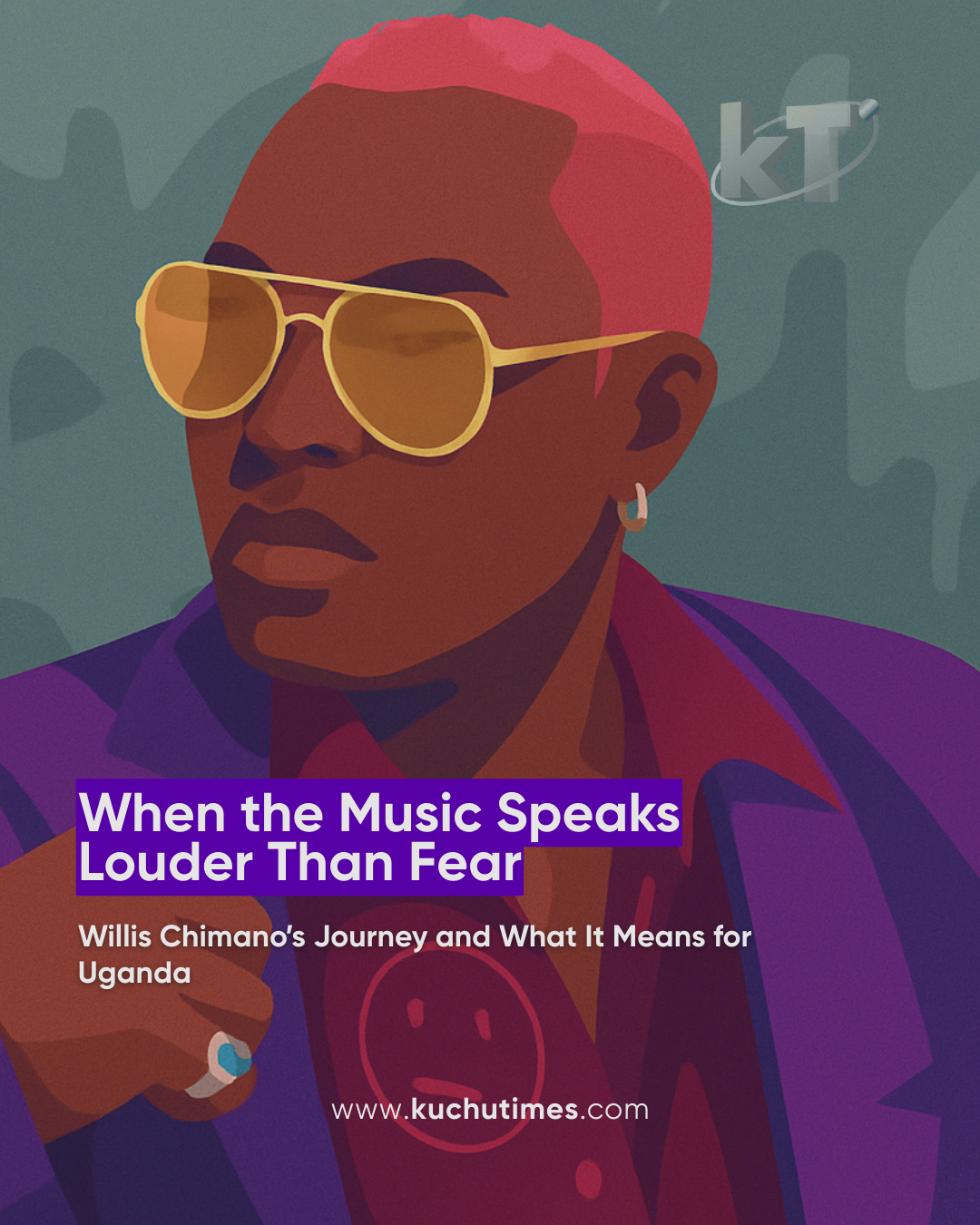
In East Africa’s bustling music scene, few voices have carried as much weight and melody as Willis Chimano’s. As one of the founding members of Sauti Sol, Africa’s biggest boy band, his story has always been tied to harmonies, fame, and regional pride. But when his personal life became public in 2018, outed before he was ready, the music suddenly competed with another narrative: one of vitriol, judgment, and the heavy burden of being queer in a region that often denies such identities even exist.
For Ugandans, Chimano’s journey feels painfully familiar. Here, where the law does not simply frown on LGBTQ+ identities but criminalises them with some of the world’s harshest penalties, the notion of being “outed” is not just an invasion of privacy; it can be a matter of life and death. His recollection of facing endless accusations—being called a sinner, un-African, against nature—echoes the same rhetoric that fuels homophobic crackdowns in Kampala, Jinja, and beyond. To listen to Chimano is to hear the story of countless queer Ugandans who cannot speak for themselves.
Yet, Chimano refused to be silenced. In 2021, he chose to claim his truth, publicly affirming his identity despite Kenya’s own colonial-era laws against homosexuality. What followed was not a retreat into the shadows but a bold leap into solo artistry, a forthcoming memoir, and the founding of the Love and Harmony Festival—a celebration of diversity, inclusion, and joy. Even when armed police stormed that festival and shut it down, Chimano’s defiance remained intact. He understood, as many Ugandans do, that resistance can be quiet or loud, but it must exist if freedom is ever to be imagined.
For queer Ugandans, the story of Chimano offers more than celebrity gossip or continental headlines. It offers a model of resilience. Here, where gatherings are raided and friendships broken by suspicion, it can be difficult to envision a future in which queer expression is celebrated rather than punished. But Chimano’s courage demonstrates that the act of simply existing openly can be revolutionary. His success, even in the face of hostility, undermines the argument that queerness is incompatible with African identity.
Chimano also issues a call to allies—a call that resonates deeply across the border. “There are more straight people who have queer friends than they admit,” he reminds us. In Uganda, that reminder is a challenge. Will families, colleagues, and congregations remain silent as their queer siblings suffer, or will they stand up and say, enough? The future of queer liberation in Uganda may depend not only on those who are forced to live in secrecy but also on those who have the power to speak freely.
In the end, Chimano’s music continues to play across Africa’s airwaves, but it is his unshakable authenticity that carries the greater rhythm. For Ugandans, his journey is not just a story from Nairobi—it is a mirror reflecting our struggles, our fears, and our hopes. And perhaps it is also a reminder that, no matter how loud the vitriol, music—and truth—can be louder still.

Leave a Reply