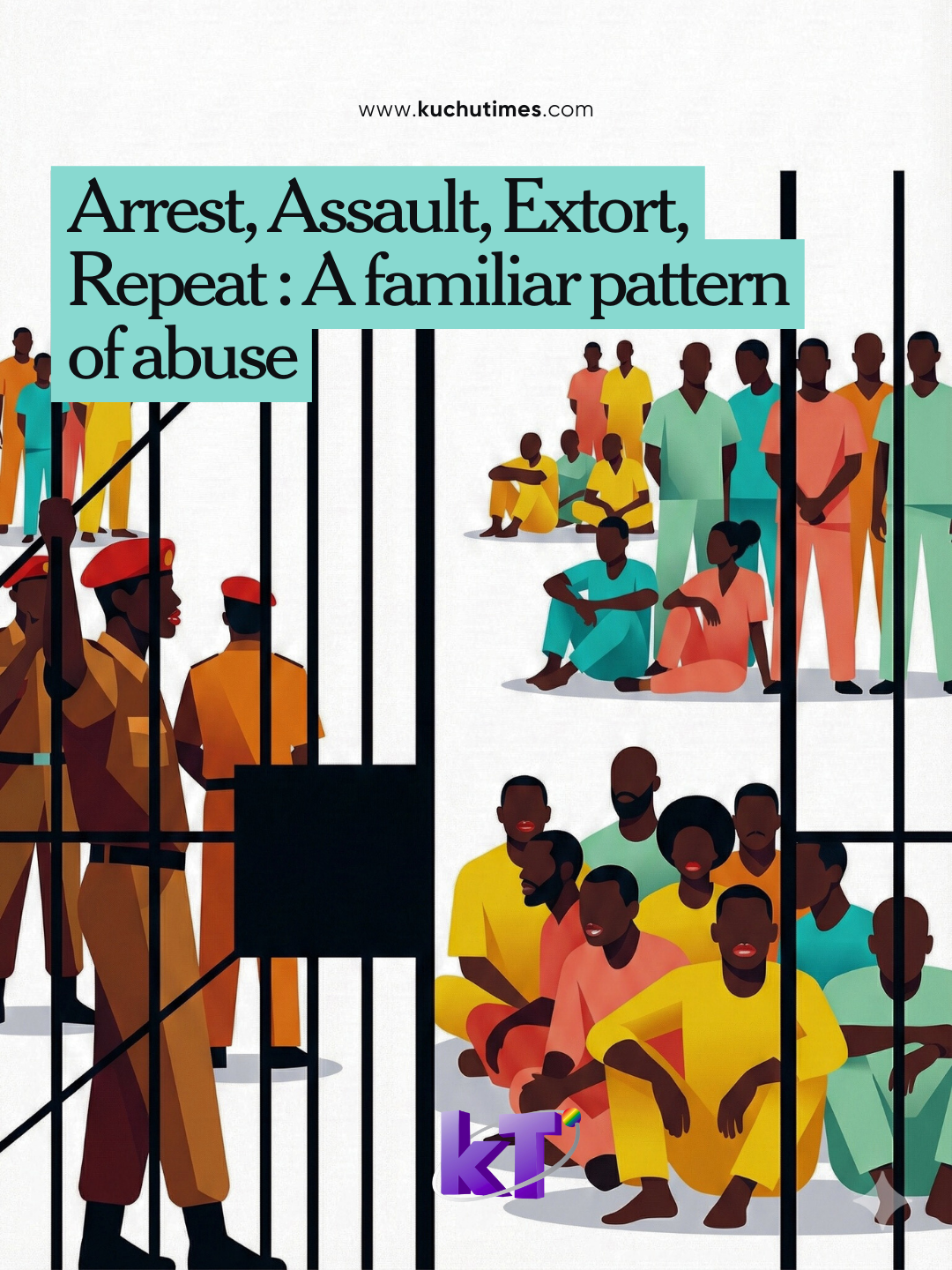
In the early hours of January 17, 2026, police officers from Wakasanke Police Post raided a home in Masanafu, arresting four young men in a scene that has become disturbingly routine across Uganda. What followed illustrates how the Anti-Homosexuality Act of 2023 has transformed into a weapon of extortion, harassment, and systemic abuse against LGBTQ+ Ugandans.
The four men arrested in Masanafu faced a familiar cycle of violence. According to documentation submitted to the Uganda Human Rights Commission by the Uganda Minority Shelters Consortium, officers physically assaulted the victims while recording videos accompanied by derogatory remarks. When demands for one million shillings went unmet, police allegedly planted marijuana in a plastic bag to justify continued detention.
Most troubling is that this was not the first encounter. The same officer, identified as Isabirye, had allegedly extorted 500,000 shillings from these individuals just three months earlier in October 2025. The escalation in demanded amounts from half a million to one million shillings suggests a calculated business model where vulnerability equals profit.
As of January 18, the detainees had been denied basic hygiene, including access to toilets, under express orders. Human rights defenders were blocked from accessing the victims, and the Officer in Charge refused to allow them to file complaints against their abusers, calling such action “sabotage.”
The aftermath proved equally devastating. After their eventual release, the survivors were evicted by their landlord, rendering the entire group homeless. They now face unresolved charges while living in precarious circumstances, their trauma compounded by destitution.
In November 2025, another case revealed the depths of institutional cruelty enabled by the Anti-Homosexuality Act. A man arrested in Kampala was transferred to Mbarara Flying Squad offices, where officers threatened to conduct a forced anal examination to “prove his sexuality.”
This practice, condemned globally as torture, violates Uganda’s own Constitution, the Prevention and Prohibition of Torture Act of 2012, and international treaties including the Convention Against Torture. Yet it persists as a tool of intimidation, made more brazen by the legal framework criminalizing same-sex relationships.
The arresting officers allegedly demanded three million shillings for his release, a preposterous amount for an individual who did not even have a job. The message is clear: your freedom, your dignity, and your body are commodities we control.
The violence extends beyond police stations into spaces that should serve as havens of learning and intellectual freedom. In October 2025, coordinated attacks targeted suspected gay students at Makerere University, with local police firing live bullets during the chaos.
Rather than condemn the violence, student leaders at Mitchell Hall released a statement that advocates describe as inciting further hostility against suspected gay students. The statement, issued on October 20, 2025, stigmatized these students and called for punitive measures, even as it acknowledged the use of live ammunition during the attacks.
The university’s silence in response has been deafening. This normalization of violence risks spreading beyond Makerere to other institutions of higher learning across Uganda, creating a climate where young people cannot pursue education without fear of mob violence or institutional abandonment.
The Anti-Homosexuality Act of 2023 did not create homophobia in Uganda, but it formalized state-sanctioned persecution and provided legal cover for extortion and violence. The law imposes severe penalties, including life imprisonment for same-sex relations and the death penalty for “aggravated homosexuality.” It also criminalizes the “promotion” of homosexuality, a vague provision that has been weaponized against human rights defenders, health workers, and anyone perceived as supportive of LGBTQ+ rights.
What these cases reveal is how the law functions in practice: not primarily as a tool of prosecution, but as an instrument of extortion and control. Police officers know that the mere threat of arrest under this law can extract money from terrified individuals who have no recourse to justice. Landlords evict with impunity. University administrators look away. And the cycle continues.
The nationwide internet shutdown from January 13-18, 2026, further illustrates how authoritarian measures compound vulnerability. During this blackout, human rights organizations could not receive or relay urgent SOS alerts in real time, leaving victims isolated and defenseless during critical moments.
Recommendations
To the Uganda Police Force:
- Immediately investigate and prosecute officers involved in extortion, assault, and planting of evidence, particularly Officer Isabirye at Wakasanke Police Post and officers at Mbarara Flying Squad
- Prohibit forced anal examinations and hold accountable any officers who have conducted or threatened such torture
- Ensure detainees’ access to legal representation, medical care, and humane treatment
- Establish independent oversight mechanisms for cases involving LGBTQ+ individuals to prevent abuse
To the Uganda Human Rights Commission:
- Conduct unannounced visits to police stations with documented patterns of abuse
- Prioritize investigations into systematic extortion schemes targeting LGBTQ+ individuals
- Issue public reports on the human rights impact of the Anti-Homosexuality Act
- Strengthen protection mechanisms for human rights defenders working on LGBTQ+ issues
To Makerere University and Other Institutions of Higher Learning:
- Issue clear public statements condemning violence against any students
- Implement protection protocols for vulnerable student populations
- Discipline student leaders who incite violence
- Create confidential reporting mechanisms for students facing harassment
- Ensure campus security protects all students equally
To Parliament and the Government of Uganda:
- Repeal or substantially amend the Anti-Homosexuality Act to bring Uganda into compliance with constitutional protections against torture and discrimination
- Ratify and implement international human rights treaties without reservations
- Restore and maintain internet access during political events to ensure human rights monitoring continues
To Civil Society and International Partners:
- Scale up emergency shelter capacity and psychosocial support services
- Document cases systematically to build evidence for accountability mechanisms
- Support legal defense funds for victims of extortion and arbitrary detention
- Advocate for international pressure on the Ugandan government to uphold human rights obligations
To the Public:
- Recognize that laws enabling discrimination against one group threaten everyone’s rights
- Report instances of police misconduct through established channels
- Support organizations providing emergency assistance to vulnerable populations
The cases documented here represent only a fraction of the daily reality for LGBTQ+ Ugandans. Behind every statistic is a person denied dignity, safety, and justice. Behind every extortion demand is a family impoverished. Behind every eviction is another person pushed to the margins of society.
Uganda’s Constitution guarantees protection against torture, inhuman treatment, and discrimination. These are not privileges to be granted selectively; they are rights that belong to every person. Until the Anti-Homosexuality Act is repealed and systemic accountability is established, that constitutional promise remains unfulfilled for thousands of Ugandans whose only crime is existing while vulnerable.
The question facing Uganda is not whether LGBTQ+ people deserve rights human rights are not earned. The question is whether Uganda will be a nation governed by law and dignity, or one where badges and bigotry combine to create a profitable system of oppression.
Names of victims have been redacted to protect their safety and privacy.