I flipped the last pages of this book on a bus while returning from somewhere, and two questions lingered in my head long after I closed it: Where will you be when the world heals from homophobia? And when will the world finally accept that people are people, regardless of their sexuality?
I come from a country, Uganda, where identifying as gay is treated as more treasonous than swindling money meant for a road construction project. Homophobia is no longer hidden. It is the new norm. Religions preach it. Politicians wear it around their necks like necklaces. People take pride in hating those who have chosen a different sexual path.
Tragically, in our society today, whatever people do not understand, they label as foreign. Homosexuality has become a heated topic debated by people who barely fathom it. In their inferences, it is colonial, imported, and evil. In effect, queerness itself has become an abuse.
Yet, when one digs deeper, a different truth emerges. Homosexuality is woven into the very fabric of our societies. It has always been here, quietly and secretly, until cultural globalists began insisting it was evil. Why? To promote fear, hatred, and division.
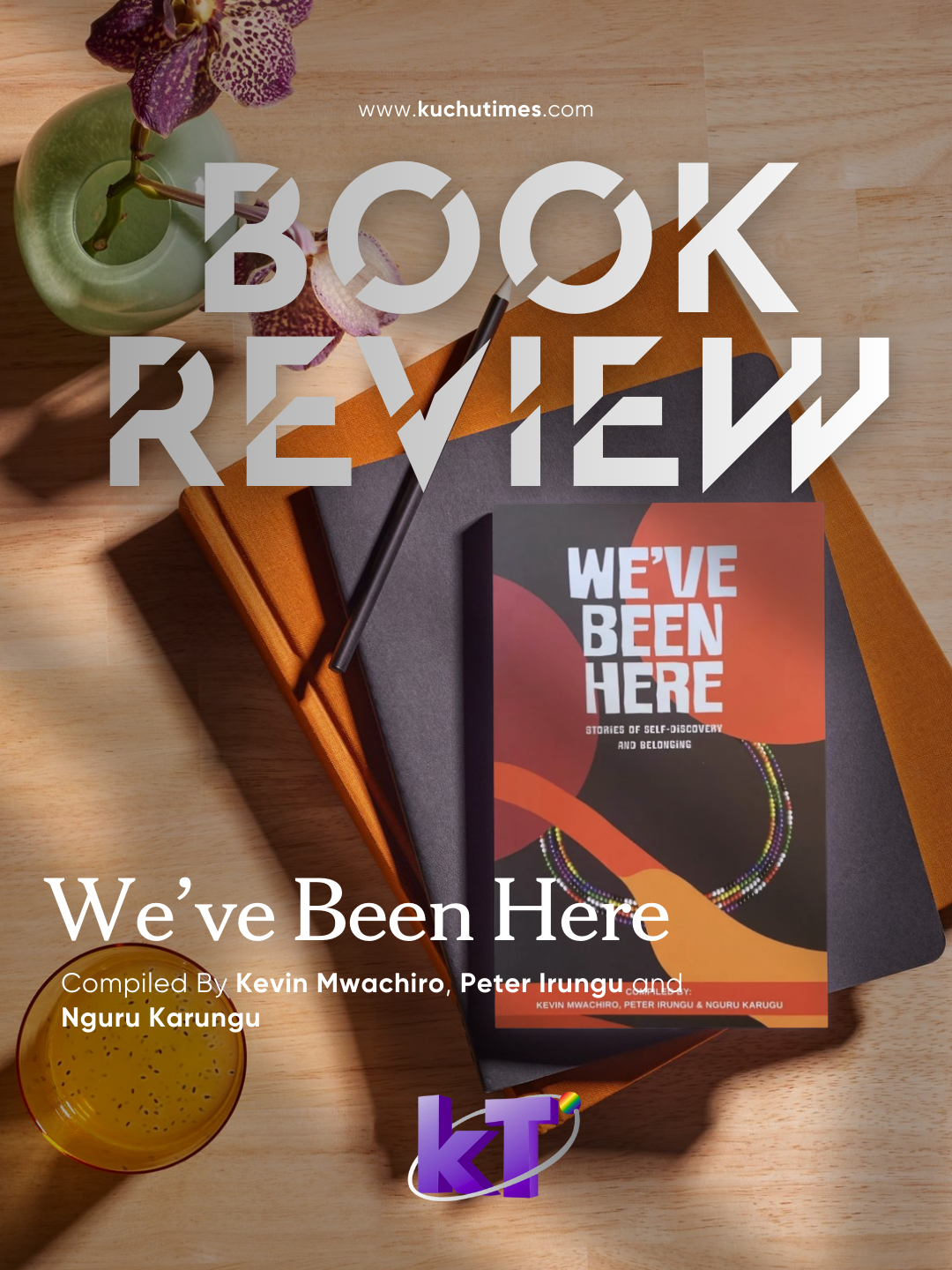
We’ve Been Here, compiled by Kevin Mwachiro, Peter Irungu, and Nguru Karugu, is a powerful testament to this truth. The book documents stories from the 1950s and 60s through the 70s, stories of self-discovery, love, loss, and belonging. These are narratives of people that history tried to erase.
Although published in 2023, the book pulls us back into a time when the struggle between individual identity and societal expectation was brutal. Conformity was a discipline. Those who refused to obey its rules were pariahs. While this policing of queer lives persists today, contemporary queer communities have at least learnt to live without some of the societal mazes, those rigid rules that once suffocated all possibility of selfhood.
Though the book focuses on the Kenyan queer community, it unmistakably mirrors the broader East African and African queer experience. The stories echo lives we have encountered across borders. Reading it is not merely encountering Kenya’s history. It is reading our collective queer history.
Historically, the book is situated during Kenya’s political transition from colonialism to self-governance. Many of the narrators were born in this era. While the period was gruelling for all Kenyans, it was especially dangerous for queer people. Christian evangelism intensified. Political unrest gnawed at daily life. Censorship thrived. There was only one state-controlled television station. Information about and for queer people was almost nonexistent.
This book is not accidental. It is a reminder that when a people’s dignity is stripped away, the story becomes the last refuge. The writing is not decorative or embellished. It is plain, honest, and unfiltered. Pain and joy coexist without censorship. The book seems to shout back at the world: you say we are not people enough. You say we must live a certain way. But this is who we are. We did not invent ourselves. We have been here since time immemorial.
The opening story, Call Me by Name, lands like a thunderbolt. Framed as a conversation between Thiaya and Nguru, it grapples deeply with identity. Society often dictates who we are, and when we submit to that script, we are condemned to carry its burden for life.
Thiaya’s story speaks not only to queer Africans of the 1950s, 60s, 70s, and 80s, but also to contemporary queer youth. Assigned the name Muthoni at birth, Thiaya always knew that this was not who they were. Something within them refused the life imposed upon them. Their journey recalls the biblical Saul becoming Paul, a shedding of one life for another. Thiaya’s story reassures young queers that it is okay to change their name, to abandon a past that does not serve them, and to live anew, even when society resists.
That self-acceptance, however, comes at a cost. Thiaya was bullied at school for refusing to perform femininity and pressured at home to behave like a woman. Yet, as Bertolt Brecht writes in In Praise of Dialectics, “Whoever has recognised his condition, who can stop him?” No one could stop Thiaya. Their certainty carried them forward, even to the halls of Kenyatta National Hospital, where they sought medical clarity about their body.
Thiaya’s story teaches queers to hold their heads high in the face of adversity. Sometimes survival demands hard choices, choices society will never applaud. Thiaya’s decision to change their name, to remove their ovaries, and to live beyond their assigned gender reflects a truth many queers know too well. Regret lies not in becoming oneself, but in surrendering to fear.
That tension between duty and desire resurfaces in An Officer in Search of a Gentleman. Here, a police officer married to a woman lives thirty-six years estranged from himself. Something remains incomplete until the day he encounters naked male bodies during a recruitment exercise. What he once dismissed as madness reveals itself as truth.
This is not only his story. Many of us recognise that moment of confusion and awakening. The pause in a café when a fellow woman’s smile ignites something unfamiliar. The involuntary longing stirred by a fellow man on a staircase. Once that recognition arrives, there is no return, only reckoning.
The officer eventually leaves his wife to pursue a life with men. Though the decision fractures expectations, it leads to honesty. He and his former wife remain friends. This is the acceptance queer people have fought for all along, the understanding that being gay is as ordinary as being straight.
Religion, too, is interrogated in this collection. While faith in Uganda today often fuels hatred toward queer people, We’ve Been Here reminds us that spirituality and queerness are not opposites. Stories like Sky’s in Everybody Knew But Me affirm that one can be queer and still seek God. Sky speaks of love, prayer, and introspection, challenging the lie that faith belongs only to the heterosexual.
The book also explores confession and coming out. VG’s decision to tell their mother the truth about their sexuality is painful yet liberating. Though difficult to accept, the mother ultimately chooses love. Confession, the book suggests, is not betrayal. It is release. It is the beginning of living truthfully.
We’ve Been Here does not shy away from the devastation of HIV/AIDS. When the disease was dismissed as the “slim disease,” queer people died in silence, unaware of what was killing them. Not until 1989 did the first Kenyan publicly disclose his status. Across Africa, queer lives were lost quietly, without care and without acknowledgement.
We’ve Been Here stands as an archive of resistance. It confronts contemporary anti-queerness, transphobia, and the dangerous myth that queerness is un-African. It honours the lives that came before us, celebrates queer survival, and insists, without apology, that our existence is neither new nor negotiable.
This book does not ask for permission. It asserts truth. And in doing so, it leaves us with a quiet, enduring reminder. Queer people have always been here, and we are not going anywhere.