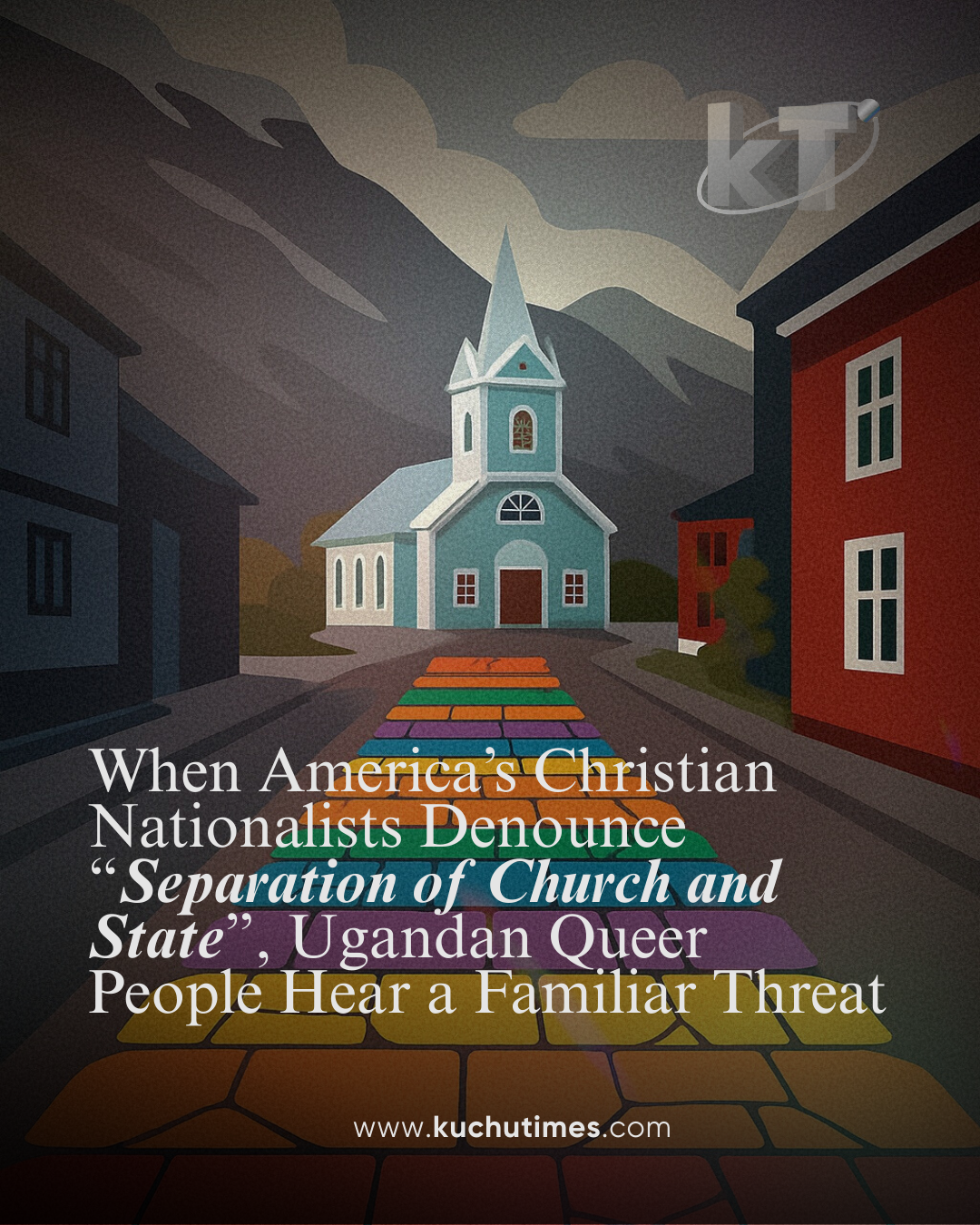
Kampala, September 2025—When Indiana’s Lieutenant Governor Micah Beckwith declared that the separation of church and state is “a dangerous falsehood weaponised to dismantle our Republic,” many Americans were shocked. For LGBTQ Ugandans, however, this kind of rhetoric feels disturbingly familiar—because we’ve lived through the consequences of politicians blurring the line between religion and governance.
The American Playbook Exported Abroad
Uganda’s harsh Anti-Homosexuality Act, which criminalises LGBTQ existence with life imprisonment and even death in some cases, did not emerge in isolation. It was fuelled by American evangelical groups who travelled to Africa, preaching the same ideology Beckwith is now pushing in the U.S. They told our leaders that queer people were “demonic,” that LGBTQ rights were part of a Western conspiracy, and that laws must reflect “biblical truth.”
Beckwith’s claim that “we are a Judeo-Christian nation” mirrors the exact messaging exported to Uganda for decades—messaging that gave cover to politicians eager to score points by scapegoating queer people. His rejection of secular governance isn’t just an American debate; it’s a global strategy that emboldens authoritarian leaders and justifies persecution.
Weaponising Religion Against Queer Lives
Beckwith has a history of vilifying LGBTQ people, calling Pride a “pagan alliance” and reposting invitations from preachers who openly advocate violence against queer communities. To him, queer people are not fellow citizens but symbols of moral decay.
In Uganda, we know where that road leads. Our families are torn apart, our friends jailed, and many of us live in hiding because leaders fused religion with state power. By branding LGBTQ people as “demons” or “ritual child sacrificers,” politicians turn public fear into state-sponsored violence.
What is alarming is that U.S. officials like Beckwith are now normalising this rhetoric inside the very democracy that once condemned Uganda’s anti-LGBTQ law. It raises a chilling question: if America abandons the principle of church-state separation, what hope remains for queer people in countries where American evangelicals already fuelled some of the world’s harshest anti-LGBTQ laws?
The Founders’ Warning Ignored
Ugandan queer activists often cite America’s Founding Fathers when pushing back against leaders who claim anti-gay laws are “Christian.” James Madison and Thomas Jefferson both argued that religion thrives best when separate from state power. They understood what leaders like Beckwith deny: that fusing church and state corrupts both faith and democracy.
But when American leaders dismiss Madison and Jefferson as irrelevant, they strengthen those in Kampala who argue that secularism is a “Western lie.” They hand Ugandan politicians the moral ammunition to say, “See? Even America agrees that governance must submit to the Bible.”
Solidarity Across Borders
For LGBTQ people in Uganda, Beckwith’s rhetoric is not an abstract culture war—it is a warning sign that the forces threatening our survival at home are gaining strength abroad. Our struggle has always been transnational. Just as American evangelicals once came to Uganda to shape our laws, American Christian nationalists now rise in their own government, determined to erase the line between church and state.
We know too well that when politicians conflate religious dominance with patriotism, queer lives become collateral damage. That is why we must speak out—not just for ourselves, but for the preservation of democracy wherever it is under siege.