

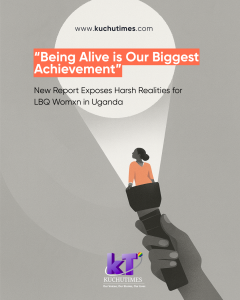
Africa Queer Network (AQNet) on Tuesday launched a landmark research study documenting the sexual and reproductive health experiences of LBTQ women across Uganda, marking a significant milestone in evidence-based advocacy despite the challenging legal environment.
The launch event brought together a diverse group of stakeholders including community members and beneficiaries, health workers, legal experts, and community leaders to discuss the findings of “Beyond Fear, Towards Care: Strengthening SRHR Access & Advocacy for LBTQ Womxn in Uganda.” The gathering reflected the collaborative approach that has defined AQNet’s work since its founding in 2021.
Guest of Honor Cleo Kambugu commended the AQNet team for their courage and persistence in conducting the research under the current restrictive climate. “This work required extraordinary bravery,” Kambugu noted, highlighting the significant risks involved in documenting LGBTQ experiences in Uganda today. Her remarks resonated with attendees who have witnessed the chilling effect of the Anti-Homosexuality Act 2023 on community organizing and health access.
A sobering reality emerged during the launch: research on LGBTQ issues cannot be certified by official research boards in Uganda because the community’s existence has been criminalized under the AHA 2023. This institutional barrier underscores the systemic erasure LBTQ persons face, even in academic and scientific spaces. Speakers emphasized that this censorship extends beyond academia, affecting the ability to generate the evidence needed for policy reform and inclusive programming.
The study, which gathered data from 50 LBTQ women across Uganda’s four regions—Central, Northern, Eastern, and Western—reveals alarming statistics about healthcare access. Over 90% of participants reported experiencing stigma and discrimination in healthcare settings, with many recounting being denied services, humiliated by providers, or told that certain services weren’t relevant to them because of their sexual orientation. Meanwhile, 80% live in fear of arrest or violence when seeking care, a fear that has intensified dramatically since the passage of the AHA.
Researchers at the launch emphasized that the intersection of patriarchy within medical institutions and homophobia creates compounding barriers that severely limit service provision for LBTQ women. “We’re facing discrimination not just as LGBTQ persons, but as women navigating a healthcare system that already marginalizes female patients,” one researcher explained. “When you add criminalization to that mix, the barriers become nearly insurmountable.“
The research documents critical gaps in access to essential services including contraception, safe abortion care, cervical cancer screening, gender-affirming services for transgender women, and mental health support. While HIV testing remains relatively accessible due to national campaigns, most other sexual and reproductive health services remain out of reach for LBTQ women. The study found that only 5% of participants had accessed safe abortion services, less than 27% had received cervical cancer screening, and fewer than 2% of transgender women could access hormone therapy through safe medical channels.
Perhaps most troubling, the research uncovered dangerous coping mechanisms born of desperation: approximately 15% of HIV-positive respondents admitted to selling portions of their antiretroviral medication to raise cash for basic necessities like food. This tragic irony—lifesaving HIV medicine being repurposed as a last-resort financial resource—highlights the intersection of poverty, criminalization, and healthcare exclusion.
The launch also featured testimonies from community members who shared their experiences navigating Uganda’s healthcare system. Their stories brought the research findings to life, illustrating the human cost of systemic discrimination and legal hostility. One participant shared how she travels three hours to Kampala to access a “gay-friendly” clinic because local facilities have denied her care. Another transgender woman described the impossible choice between accessing gender-affirming care and risking arrest.
AQNet Founder and Executive Director Agnes Nshemeirwe closed the event with a powerful call to action, emphasizing that healthcare is a human right that cannot be contingent on sexual orientation or gender identity. “This research says: we are here, we have needs, and we will not be ignored,” she stated. “It provides the evidence needed to demand change, and it honors the resilience of our community.“
The report includes comprehensive recommendations for policymakers, healthcare providers, donors, and community organizations. These include repealing discriminatory provisions of the AHA, mandating sensitization training for healthcare workers, scaling up community-based clinics that serve LBTQ persons, and ensuring that international donors enforce non-discrimination clauses in their funding agreements.
Read the full report here: https://heyzine.com/flip-book/7678856058.html
The study was conducted with strict ethical protocols to protect participants’ safety and anonymity, a necessity given the current legal climate. Data collection took place across all four regions of Uganda, ensuring that rural voices , often the most marginalized, were included in the findings.

Leave a Reply